

RADAR
The RADAR Pathway™
Get off the X: Your Map From Recognition to Recovery
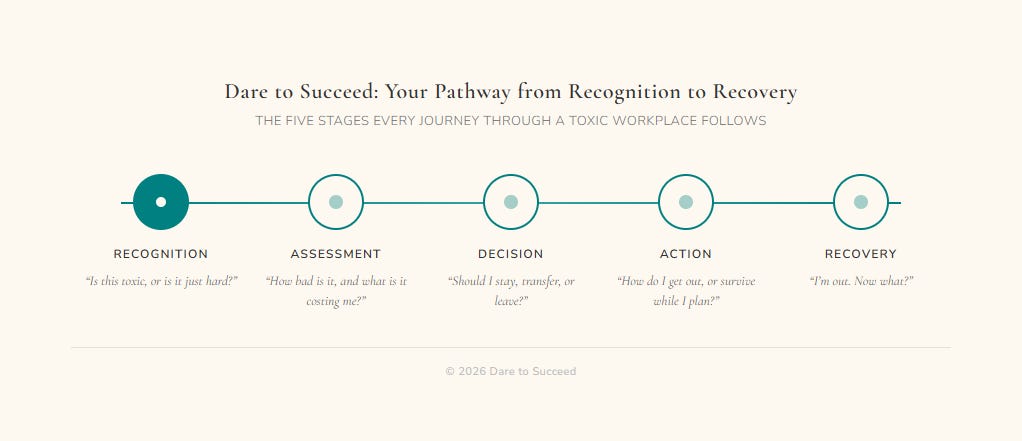
For nearly two decades, I have surveyed and interviewed hundreds of professionals who navigated toxic workplaces. Their journeys were different in the details, but they followed the same five stages.
I call this The RADAR Pathway™:
Recognition
Assessment
Decision
Action
Recovery.
It is the backbone of everything in Dare to Succeed. Every tool, every framework, and every story maps to one of these stages.
This page shows you the full system: what each stage involves, what tools exist at each stage, and how they connect to each other. Think of it as a map. This page is where you see the whole terrain. The Start Here page is where you begin.
Stage 1: Recognition
Dare to see it.
“Is this toxic, or is it just hard?”
You are in pain, confused, or watching someone you care about suffer. You need validation before anything else. The work at this stage is naming what is happening: recognizing that what you’re experiencing is not normal workplace friction, not a personal failing, and not something you should just push through.
Tools at this stage:
Situation Clarity Check (Free): Ten questions across three dimensions: leadership behavior, personal impact, and organizational patterns. It won't tell you what to do, but it will tell you whether what you're experiencing is normal workplace friction or something more.
False Promise Test (Free): A focused assessment for the single most common trap: being promised promotions, raises, or changes that never come. Based on the false promise cycle identified in the research.
Pattern Recognition Quick-Scan (Free): A two-page tool identifying the seven behavioral cycles that show up again and again in toxic workplaces: false promises, gaslighting, isolation, credit stealing, public humiliation, information hoarding, and scapegoating.
Access: Free on Substack
Stage 2: Assessment
Dare to count the cost.
“How bad is it, and what is it costing me?”
You know something is wrong. Now you measure the damage. This stage asks you to look honestly at what this environment has taken from your confidence, your health, your finances, and your relationships. It also asks you to look at the financial realities that may be keeping you in place. The tools here replace gut feelings with concrete numbers.
Tools at this stage:
Invisible Armor Audit: A self-assessment that inventories the protective behaviors you’ve adopted.
Financial Freedom Assessment: Calculates your “freedom number.”
Access: Available at www.molnarrc.com
Deeper support: Assessment is covered in weeks 1-3 of cohorts. 1:1 Get Off the X strategy sessions can walk through these frameworks with you.
Stage 3: Decision
Dare to choose.
“Should I stay, transfer, or leave?”
This is the stage your entire situation has been building toward. You have the data from the assessment. Now you weigh your paths forward. The tools here replace circular thinking with structured analysis. They do not tell you what to decide. They help you see the full picture so you can trust your own judgment.
Tools at this stage:
Decision Matrix: Stay, Transfer, or Leave: A weighted assessment across seven dimensions.
“Should I Report This?” Framework: A structured assessment for deciding whether to report toxic behavior to HR, management, or external authorities.
Access: Available at www.molnarrc.com
Deeper support: Decision is covered in weeks 4-6 of cohorts. The “Stay, Go, or Prepare” workshop addresses this stage directly.
Stage 4: Action
Dare to move.
“How do I get out or survive while I plan?”
The decision is made. Now it needs to be executed. Whether you are leaving, transferring, or staying while you build your exit plan, the tools at this stage turn your decision into a sequence of concrete steps. This is where frameworks become execution plans.
Tools at this stage:
Exit Blueprint: A four-phase exit plan. Includes a Plan B for compressed timelines and a “red line” for when to leave before the plan is complete.
Negotiation Map: For people who are staying in the short term. How to navigate a toxic environment while protecting yourself.
Workplace Recon Tool: A due diligence checklist for evaluating new opportunities.
Access: Available at www.molnarrc.com
Deeper support: Action is covered in weeks 7-12 of cohorts. The “Exit Without Burning Bridges” workshop addresses this stage. 1:1 Get Off the X strategy sessions provide 1:1 support through execution.
Stage 5: Recovery
Dare to begin again.
“I’m out. Now what?”
Leaving a toxic environment does not instantly restore who you were before it. The armor does not come off overnight. The research identified three post-exit risks: crashing (adrenaline withdrawal in the first weeks), repeating the pattern (unconsciously choosing another toxic environment), and stalling (inability to trust leadership again). The tools at this stage address all three.
Tools at this stage:
Recovery Roadmap: A phased guide to rebuilding. Phases 1-3.
Red Flag Checklist: Designed to prevent the repeat pattern.
Access: Available at www.molnarrc.com
Deeper support: The Recovery Cohort (8 weeks) is designed specifically for this stage. The “Screening Your Next Job” workshop addresses red flag recognition. 1:1 Get Off the X strategy sessions provide 1:1 support through rebuilding.
Where to Start
You don’t need to figure out which stage you’re in before you begin. Start with the Situation Clarity Check. It takes five minutes, and your results will tell you where you are on this map.
Subscribe to Dare to Succeed (free), and you’ll receive all three recognition tools in your welcome message. From there, the pathway will guide you.
You’re not alone. You’re not crazy. And you have more options than you can see right now.